Identify the assembly · verify the system · write the scope
Start with the top.
A chimney cap, a chase cover and a masonry crown are not interchangeable names. Select what you see—or the symptom you noticed—and carry the right component into the request.
No photo-only fit promise · no universal attachment detail · exact installation follows the identified listed system and applicable requirements
Urgent condition?
If metal or masonry is loose or falling, the chimney appears unstable, there is an active fire, a CO alarm, smoke filling the home or a suspected gas leak, leave the danger area and contact emergency services. Do not use this routine request path.
COMPONENT ROUTER · NOT A DIAGNOSIS
Three parts. Three different jobs.
Choose the closest match. The page changes the questions, the written-scope requirements and the service carried to the form.
AT THE FLUE OPENING
It protects an opening—not the entire top assembly.
A well-designed cap can help keep rain, animals and debris out of the flue opening. It still has to fit the actual flue or listed chimney system and preserve required exhaust area and service access.
LOOK FOR
Missing hood, damaged screen, corrosion, looseness, poor fit or obstruction at the termination.
DOCUMENT
Flue count, shape and dimensions; liner or system type; existing attachment; top condition; safe access.
DO NOT ASSUME
That any stock cap fits, that a screen detail is universal, or that a cap resolves every water symptom.
WHAT CHANGED?
You do not need the component name.
Select the clearest observation. This is intake routing, not a remote diagnosis.
Select an observation to see what the intake should preserve.
THE MEASUREMENT CONTRACT
A photo starts context. It does not finish fabrication.
Exact requirements vary with the identified chimney system, manufacturer instructions and applicable code. A written option should show what was measured and which detail controls the installation.
Appliance, fuel, liner or factory-built chimney identification and available labels/manuals.
02
Openings & penetrations
Count, type, dimensions, spacing and every penetration through the top assembly.
03
Outside geometry
Chase or masonry dimensions, slope, overhang, edge detail and out-of-square conditions.
04
Existing condition
Corrosion, cracks, seams, standing-water pattern, attachment and surrounding deterioration.
05
Access & interface
Roof pitch, height, staging, storm collar, flashing, service removal and adjacent work.
SYSTEM-SPECIFIC BY DESIGN
The manual beats a generic detail.
Published factory-built chimney instructions show separate parts—cap, storm collar and chase-top flashing—and prescribe model-specific spacing, ventilation, sealing and clearance details. That is why a remote photo cannot responsibly establish fabrication or attachment.
For a masonry chimney, published code language treats the sloped top cap/crown, drip edge, flue-liner transition and rain-cap opening as distinct details. The selected scope must name which one is being addressed.
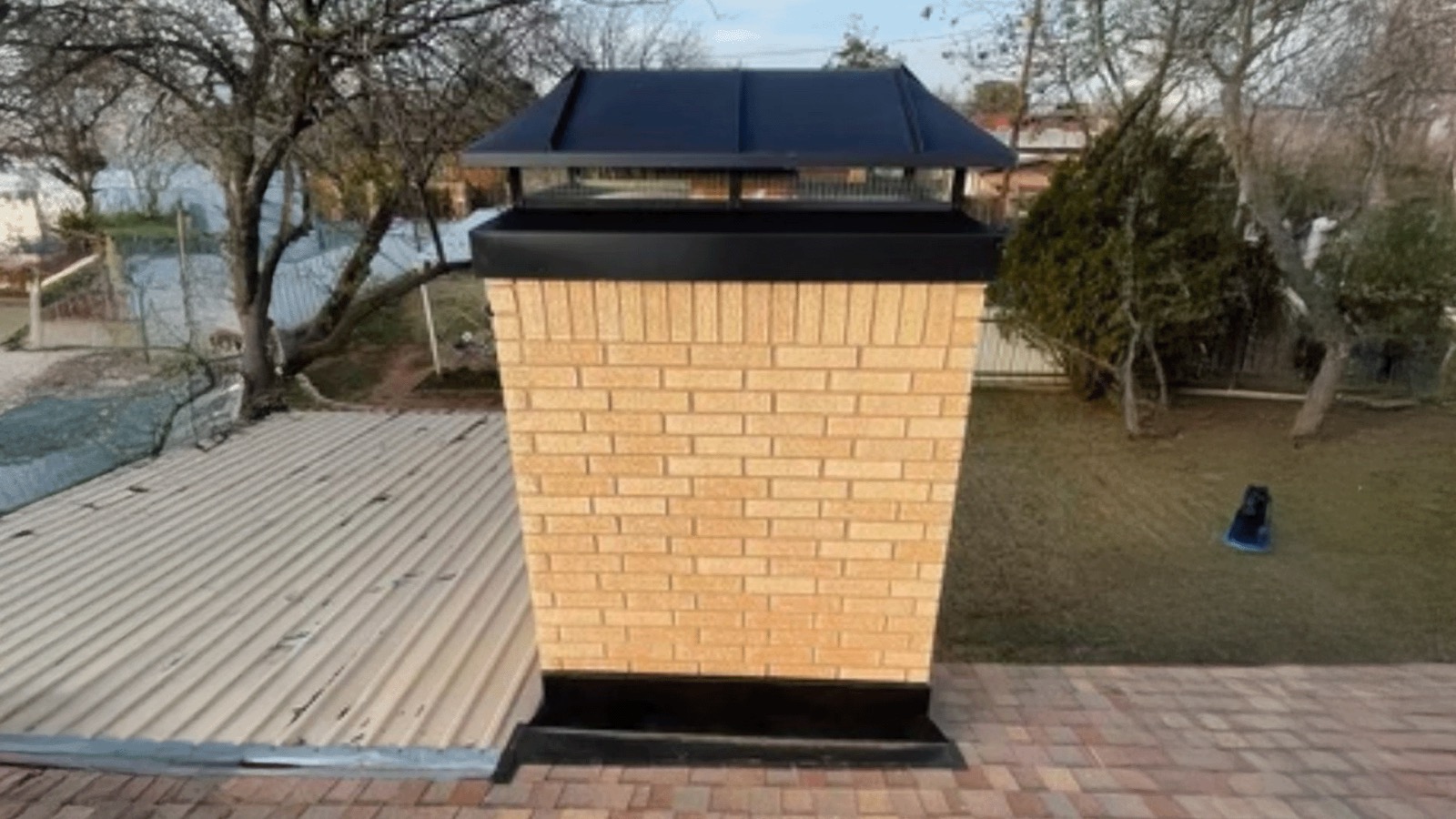
EXISTING CHIMNEY4U PROJECT MEDIA · VISIBLE INSTALLED CONFIGURATION
PROOF BOUNDARY
What this image actually proves.
It supportsA visible black metal top assembly installed over the photographed brick chimney.
It does not proveDimensions, material or gauge, system compatibility, concealed integration, ventilation, clearance, code outcome, water performance or warranty.
The reviewed job record is required before any stronger public claim.
WRITTEN SCOPE OUTPUT
Before price, preserve the decision.
01Named component
Cap, chase cover or masonry crown—never an ambiguous “top repair.”
02System & measurements
Identification, dimensions, openings, penetrations and access limitations.
03Material & geometry
Only when confirmed: material/gauge, seams, slope, edges and collars.
04Attachment & access
Installation basis, removal/cleaning access and adjacent responsibility.
05Exclusions & changes
Unknown concealed work, roofing boundaries and review before added scope.
06Completion record
Installed work, deviations and labeled photos—not a blanket outcome claim.
WHY PRICES DIFFER
The visible metal is only one driver.
Stock or custom geometryOpenings, penetrations, shape and fabrication complexity.
System compatibilityListed parts, clearances, ventilation and manufacturer requirements.
Material and conditionConfirmed specification, corrosion, substrate and adjacent deterioration.
Roof accessHeight, pitch, staging, protection and weather window.
Responsibility boundaryChimney, roofing, appliance and concealed interface work.
COMMON QUESTIONS
Clear names. Safer answers.
What is the difference between a cap and a crown?+
A cap normally protects a flue opening. A masonry crown or wash is the sloped top surface over a masonry chimney. They can exist on the same chimney and fail independently.
What is the difference between a cap and a chase cover?+
A flue cap sits at a termination. A chase cover spans the top of a framed chase and is penetrated by one or more chimney sections; the storm-collar and system details also matter.
Can you quote a custom cover from one photo?+
A photo can help identify configuration and access. Fabrication still needs verified geometry, penetrations, system details, material specification and an installation basis.
Will a new cap or cover guarantee the leak is fixed?+
No single top component should be promised as the water source or cure before other paths—crown, flashing, masonry, roof and concealed transitions—are evaluated.
Can a cap help with animals and debris?+
A properly selected cap can help exclude rain, birds, animals and debris at the opening, but screen, exhaust-area, cleaning-access and listed-system requirements must still be preserved.
When is custom fabrication considered?+
When verified geometry, multiple penetrations, the existing assembly or the approved design cannot be served by an appropriate listed or stock component. “Custom” is an outcome of the measurement—not a default upsell.
NEXT STEP
Start with the flue opening.
Tell us what changed and attach the clearest safe photos you already have. A person confirms serviceability and the assessment path.
Request a cap assessment →Serviceability, scope, price, availability and appointment status require team confirmation.
Prototype publication gate
Owner truth, technical review, system identification, component evidence, ZIP rules, terms and production tracking remain required before removing noindex.
Page ID P08 · version 0.1 · evidence basis: visible public project media + cited technical sources